Lessons of drawing with sand


Are you an artist and would like to learn new material? Or maybe just you would like to digress from the ordinary and find a new hobby. No matter who you are by profession, how old are you, the important thing is the desire to learn something new and beautiful. I'll be happy to help you.
Course of drawing with sand - 13 video lessons
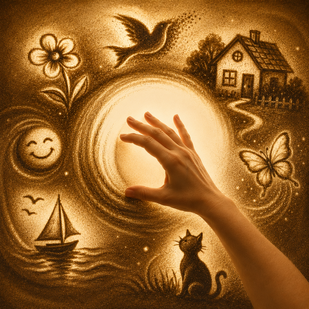
Welcome to the world of sand art animation.
In this course, you will learn how to transform simple sand drawings into powerful visual storytelling. This is not just about drawing — it’s about composition, light, movement, transformation, and building an emotional narrative through images.
Throughout 13 structured lessons, we will cover the foundations of visual art — composition, perspective, anatomy, light and shadow — and adapt them specifically to the sand medium. You will learn how to create fluid transitions, how to transform one image into another without fully erasing the surface, and how to build a complete storyboard for a 10–20 minute performance.
By the end of this course, you will be able to create your own sand animation video or develop a live sand performance with confidence and artistic control.
If you are an artist, performer, storyteller, or simply someone who wants to explore a unique visual medium — this course will give you both the technical tools and the artistic understanding to do so.
I invite you to take the next step and begin creating your own sand art stories.
- How to draw on sand.
- How to draw with sand.
- Volume in sandart.
- Perspective in sandart.
- Composition.
- Flowers.
- Animals.
- Humen figure.
- Humen hands.
- Portraits
- Facial Expression.
- Color sand.
- Sand storybourd - "Alice in Wonderland".
1. Sandart lesson - "How to draw with sand".
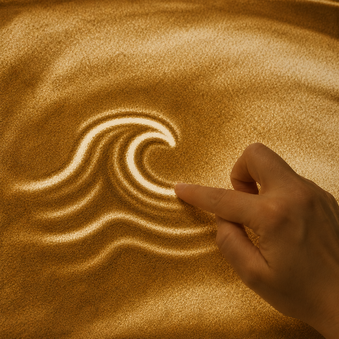
Want to learn how to draw with sand?
In this lesson you will discover the fundamental techniques of sand drawing and learn how to control this unique material using only your hands.
We begin by exploring the surface used for sand animation and understanding how sand behaves when applied to light. Then you will learn how to use different parts of your hand as drawing tools: fingers, fingertips, nails, the side of the hand, and the palm.
Through simple demonstrations you will see how these techniques allow you to create lines, shapes, textures, and expressive effects in sand.
This technical foundation is essential for anyone who wants to start creating sand drawings, sand animation, or live sand performances.
In this lesson you will learn:
• how to control sand on a light surface
• how to use fingers, nails and palms as drawing tools
• how to create lines, shapes and textures with sand
• the basic techniques used in sand animation
By the end of the lesson you will understand how sand works as an artistic material and will be ready to begin creating your own sand drawings.
2 Sandart lesson - "How to draw with sand".

Ready to start drawing with sand?
In this lesson you will learn the fundamental techniques for applying sand to the drawing surface and creating your first shapes and forms.
You will discover how professional sand artists control the flow of sand using different hand movements. I will show you how to take sand correctly and release it with precision using several essential techniques: sprinkling sand with your fingers, drawing with a pinch, pouring sand from your hand, and controlling the amount of sand you place on the surface.
These techniques are the foundation of sand drawing and sand animation. Once you understand how to control the material, you will be able to create smooth lines, textures, shadows, and expressive forms.
In this lesson you will learn:
• how to take sand correctly with your hand
• how to sprinkle sand using the pinch technique
• how to pour sand and control the flow of material
• how to create shapes and textures with sand
• how to begin building drawings using sand techniques
By the end of this lesson you will understand the basic movements used in sand drawing and will be able to start creating your own images with sand.
3. Sandart lesson - "Volume"

In this lesson, you will learn how to create volume in sand animation. We begin with simple geometric forms and explore how light, shadow, and contrast transform flat shapes into three-dimensional objects. Once these principles are understood, we apply them to recognizable subjects such as fruits and other everyday objects, discovering how complex forms are built from simple shapes. By the end of the lesson, you will have a clear understanding of how to add depth and dimension to your sand drawings.
4. Sandart lesson - "Perspective"

In this lesson, you will explore the principles of perspective and learn how to create depth and space in sand animation. We will work with linear perspective, aerial perspective, and axonometric drawing, discovering how different methods help represent objects in space. Through practical exercises, you will learn how to build landscapes, place objects at different distances, and create convincing three-dimensional scenes using sand.
5. Sandart lesson - "Composition"

In the previous lessons, we explored volume and perspective in sand animation. Now it is time to bring these skills together through composition.
In this lesson, you will learn the fundamental principles of visual composition and discover how to arrange objects harmoniously within a scene. We will work with still-life subjects, combining simple geometric forms with recognizable objects such as fruits and vessels.
You will learn how to balance objects, control visual weight, create focal points, and build clear relationships between elements. We will also explore how composition helps guide the viewer’s eye and makes an image feel organized, natural, and visually engaging.
By the end of this lesson, you will understand how to create balanced compositions and confidently arrange objects within your sand drawings.
6. Sandart lesson - "Flowers"
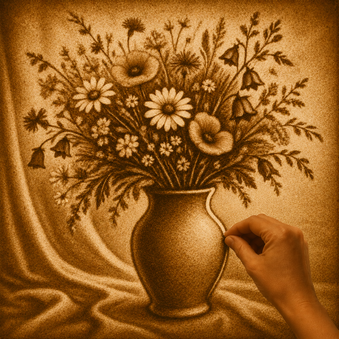
Flowers are one of the most expressive and versatile subjects in sand animation. In this lesson, you will learn how to draw a wide variety of floral forms, from simple individual blossoms to more complex arrangements.
We will explore wildflowers, seasonal flowers, bouquets, and floral compositions in a vase. You will learn how to simplify complex shapes, organize petals and stems, create depth within a bouquet, and build harmonious floral scenes.
By the end of the lesson, you will be able to confidently draw individual flowers as well as complete floral compositions in your sand artwork.
7. Sandart lesson - "Animals"

In this lesson, we bring together everything we have learned so far and apply it to one of the most fascinating subjects in art — animals.
We will learn how to construct animal heads and bodies using simple geometric forms, understand their proportions, and develop a sense of structure. Starting with basic shapes, we will gradually build recognizable animals, exploring both static poses and dynamic movement.
The lesson includes a variety of subjects, from domestic animals to wildlife and birds. We will study how volume, light, shadow, and composition work together to create convincing animal portraits and full-body figures.
By the end of this lesson, you will understand how complex animal forms can be simplified into basic shapes and confidently transformed into expressive sand drawings.
8. Sandart lesson - "Human figure"
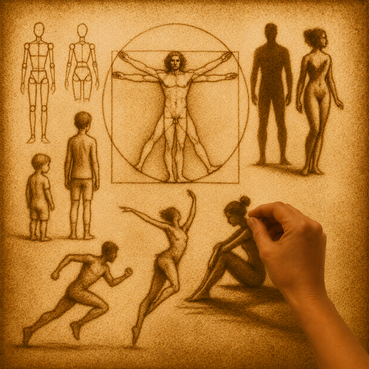
The human figure is one of the most challenging and rewarding subjects in art. In this lesson, we will explore the fundamentals of human anatomy and learn how to construct the body using simple shapes and proportions.
You will discover the differences between adult and child proportions, male and female figures, and learn how to draw both static poses and dynamic movement. We will break complex forms into simple structures, making the human body easier to understand and draw.
Using the principles of volume, perspective, and composition learned in previous lessons, you will learn how to create expressive and convincing human figures in sand animation. By the end of the lesson, you will have a solid foundation for drawing people in a variety of poses and styles.
9. Sandart lesson - "Hands"
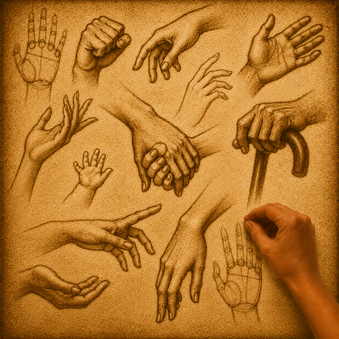
Hands are one of the most expressive and challenging subjects in art. In this lesson, we will study the anatomy and structure of the human hand and learn how to draw it from different angles and in a variety of gestures.
We will explore the differences between children's, adult, male, female, and elderly hands, paying attention to proportions, form, and character. You will learn how to simplify complex hand structures into basic shapes, making them easier to understand and draw.
Using the principles of volume, perspective, and anatomy, we will create hands in both static and dynamic positions. By the end of the lesson, you will be able to confidently draw hands in a wide range of poses and use them effectively to add expression and emotion to your sand animations.
10. Sandart lesson - "Portrait"
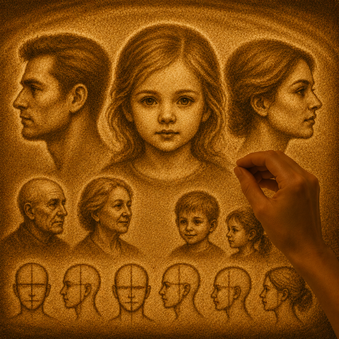
Portraits are among the most powerful and expressive subjects in sand animation. In this lesson, we will explore the structure and proportions of the human face and learn how to draw portraits from different angles, including both front and profile views.
We will study the anatomical foundations of facial construction and examine the differences between male, female, and children's faces. Understanding age, gender, and individual facial characteristics will help you create more convincing and recognizable portraits.
You will learn how to simplify complex facial features into clear shapes and proportions, making the drawing process easier and more accurate. We will also explore different approaches to portrait creation in sand animation, from basic construction to finished expressive portraits.
By the end of this lesson, you will have a solid understanding of facial structure and be able to confidently create portraits of different ages and characters in your sand artwork.
11. Sandart lesson - "Facial expression"
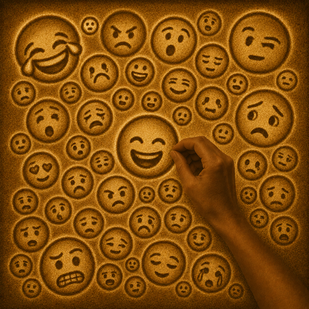
A face becomes truly expressive when it conveys emotion and tells a story. In this lesson, we will explore how facial expressions are created and how even small changes in the eyes, eyebrows, mouth, and facial muscles can completely transform a character's appearance.
We will study a wide range of emotions, including joy, sadness, surprise, fear, anger, and curiosity. You will learn how to simplify these expressions and clearly communicate them through sand animation.
The second part of the lesson is dedicated to age transformation. We will examine how facial proportions and features change throughout life, from childhood to old age. By understanding these age-related characteristics, you will be able to create convincing transitions between different stages of life and develop more expressive characters.
By the end of this lesson, you will know how to draw a variety of emotions, portray different ages, and transform one face into another while maintaining clarity and visual impact.
12. Sandart lesson - "Color sand"

Color opens up new creative possibilities in sand animation. In this lesson, we will move beyond monochrome drawings and explore the exciting world of colored sand.
You will learn how different colors interact with one another, how to mix them to create new shades, and how to use color intentionally to strengthen the mood and visual impact of an image. We will explore the basic principles of color harmony and discover how a limited palette can produce a wide variety of tones.
Using simple subjects such as the rainbow, the sun, clouds, and decorative elements, we will practice working with multiple colors while maintaining clean shapes and clear composition. Special attention will be given to layering colored sand and creating smooth transitions between colors.
By the end of this lesson, you will understand the fundamentals of color in sand animation and be able to confidently create vibrant, expressive artwork using colored sand.
13. Sandart lesson - "Alice in Wonderland"
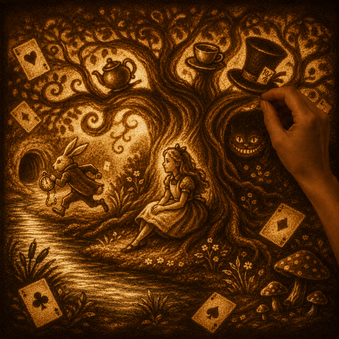
This final lesson brings together everything you have learned throughout the course. We will focus on creating a complete sand animation story from the initial idea to the finished performance.
The lesson begins with storyboard development. You will learn how to transform an idea into a sequence of scenes, organize visual transitions, build a narrative structure, and maintain the viewer's attention from beginning to end.
As a practical example, we will create an original interpretation of the classic story Alice in Wonderland. Together, we will analyze the story, select key moments, simplify them into visual symbols, and transform them into a coherent sand animation sequence.
Throughout this project, you will apply all the skills acquired in previous lessons: composition, perspective, volume, anatomy, portrait drawing, emotions, color, and character design. You will learn how to combine these individual techniques into a single visual language and create smooth transitions between scenes.
By the end of this lesson, you will understand the complete process of developing a sand show and gain the confidence to create your own original stories, performances, and artistic projects from concept to final presentation.